
The UNA Resources, Local Updates Blog
Stop trying to find information all over the web. Start below with a simple access to read the blog’s United Nurse of Alberta (UNA) resources, UNA Local 115 updates and our newsletter so you can be informed!
How to check if you’re receiving your Education Allowances
How to check if you’re receiving your Education Allowances
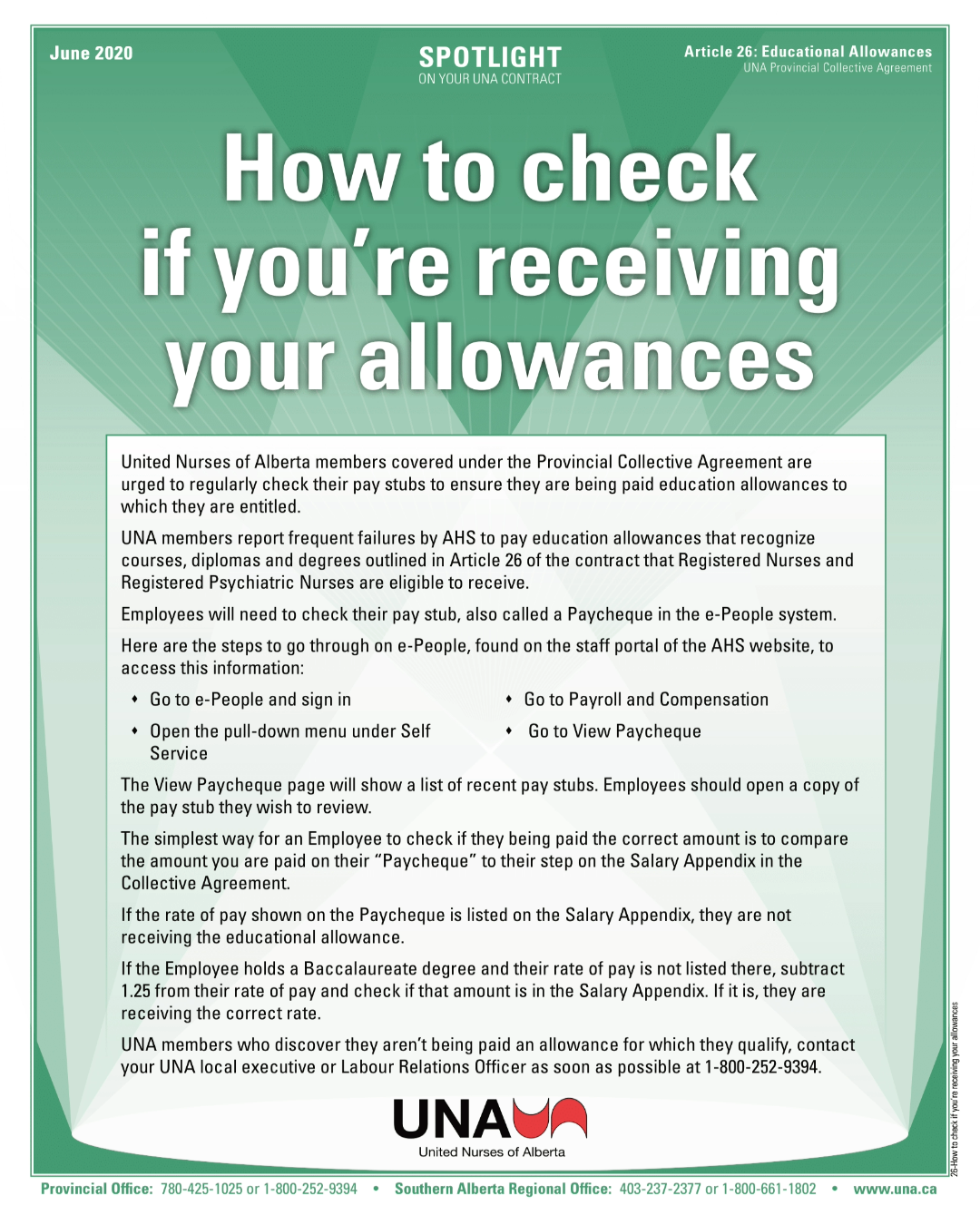
United Nurses of Alberta members covered under the Provincial Collective Agreement are urged to regularly check their pay stubs to ensure they are being paid education allowances to which they are entitled. UNA members report frequent failures by AHS to pay education allowances that recognize courses, diplomas and degrees outlined in Article 26 of the contract that Registered Nurses and Registered Psychiatric Nurses are eligible to receive. Employees will need to check their pay stub, also called a Paycheque in the e-People system. Here are the steps to go through on e-People, found on the staff portal of the AHS website, to access this information: Go to e-People and sign in Open the pull-down menu under Self Service Go to Payroll and Compensation Go to View Paycheque The View Paycheque page will show a list of recent pay stubs. Employees should open a copy of the pay stub they wish to review. The simplest way for an Employee to check if they being paid the correct amount is to compare the amount you are paid on their “Paycheque” to their step on the Salary Appendix in the Collective Agreement. If the rate of pay shown on the Paycheque is listed on the Salary Appendix, they are not receiving the educational allowance. If the Employee holds a Baccalaureate degree and their rate of pay is not listed there, subtract 1.25 from their rate of pay and check if that amount is in the Salary Appendix. If it is, they are receiving the correct rate. UNA members who discover they aren’t being paid an allowance for which they qualify, contact your UNA local executive or Labour Relations Officer as soon as possible at 1-800-252-9394.




How Safe is Your Workplace: A Reproductive Risk Story
How Safe is Your Workplace: A Reproductive Risk Story


Part-time Employees have right to reschedule when a scheduled day falls on a named holiday
Part-time Employees have right to reschedule when a scheduled day falls on a named holiday
Part-time Employees have the right to request to reschedule a scheduled day that falls on a named holiday. Under Article 18.03 (c) of the current UNA Provincial Collective Agreement (which is amended in Article 30 of the Agreement) “where a part-time Employee is not scheduled to work on what would otherwise be a regular work day directly as a result of a Named Holiday, those hours may, at the request of the Employee, be rescheduled in the Cycle of the Shift Schedule.” This means an Employee may choose whether or not to make a request. If the Employee makes a request then the hours must be rescheduled in the Cycle of the Shift Schedule. This provision gives employees the option of adding an additional shift somewhere else during the impacted week and avoids a reduction in pay for that pay period. For those Employees who do not make a request to reschedule the shift, they receive an additional 5 per cent pay in lieu of the paid time off for a named holiday provided to a Fulltime Employee.

Employer must indicate denial of vacation requests in writing
Employer must indicate denial of vacation requests in writing
Article 17.03 of the UNA Provincial Collective Agreement states that all vacation earned during one vacation year shall be taken during the next following vacation year at a mutually agreeable time. At most UNA sites, the employer must inform the employee of approval or denial of their requests on the vacation planner by April 30. Under Article 17.03 (b) (ii) the Employer must indicate approval or denial of the vacation request in writing within 14 days of the request. In addition, it is management’s job to find a replacement. The vacation planner is intended to assist the Employer with that task. So Employees should not be required to find their own replacement in order to have their vacation approved. If there is a delay in the approval beyond the deadline, or if the employer says it is pending, the employee should consider their vacation denied and initiate a grievance immediately. Grievances should be filed within 10 days (excluding weekends and named holidays) of April 30 or from the day you were informed of vacation decisions, whichever is earlier. For more information, contact your UNA local executive or your UNA Labour Relations Advisor at 1-800-252-9394.

Casual Employees eligible for overtime when they work beyond their scheduled shift hours
Casual Employees eligible for overtime when they work beyond their scheduled shift hours
When Casual Employees are offered a shift, they should confirm the length of the shift they are being asked to work. This is important information as Casual Employees are eligible for overtime if they work beyond their scheduled shifts hours. However, Casual Employees must work a minimum of 7.75 hours to be eligible for overtime. If a Casual if replacing a regular Employee, any hours they work beyond what the regular Employee would have worked (7.75 hrs or an extended hour shift) is deemed to be overtime and paid at 2X the basic rate of pay. When a Casual is offered a shift that does not replace a regular Employee, they should confirm the number of hours they are booked to work. Any hours worked beyond the scheduled shift length and in excess of 7.75 hours should be paid at 2X the basic rate of pay. If a Casual Employee is scheduled to work a 4 hour shift and is asked to stay an addition 3.75 hours (total of 7.75 hours), they are not eligible for overtime. Make sure you claim overtime when it is appropriate. If your Employer denies your request for overtime, contact your Local Executive or Labour Relation Officer as soon as possible.
Ability Management and Sick Leave
Ability Management and Sick Leave
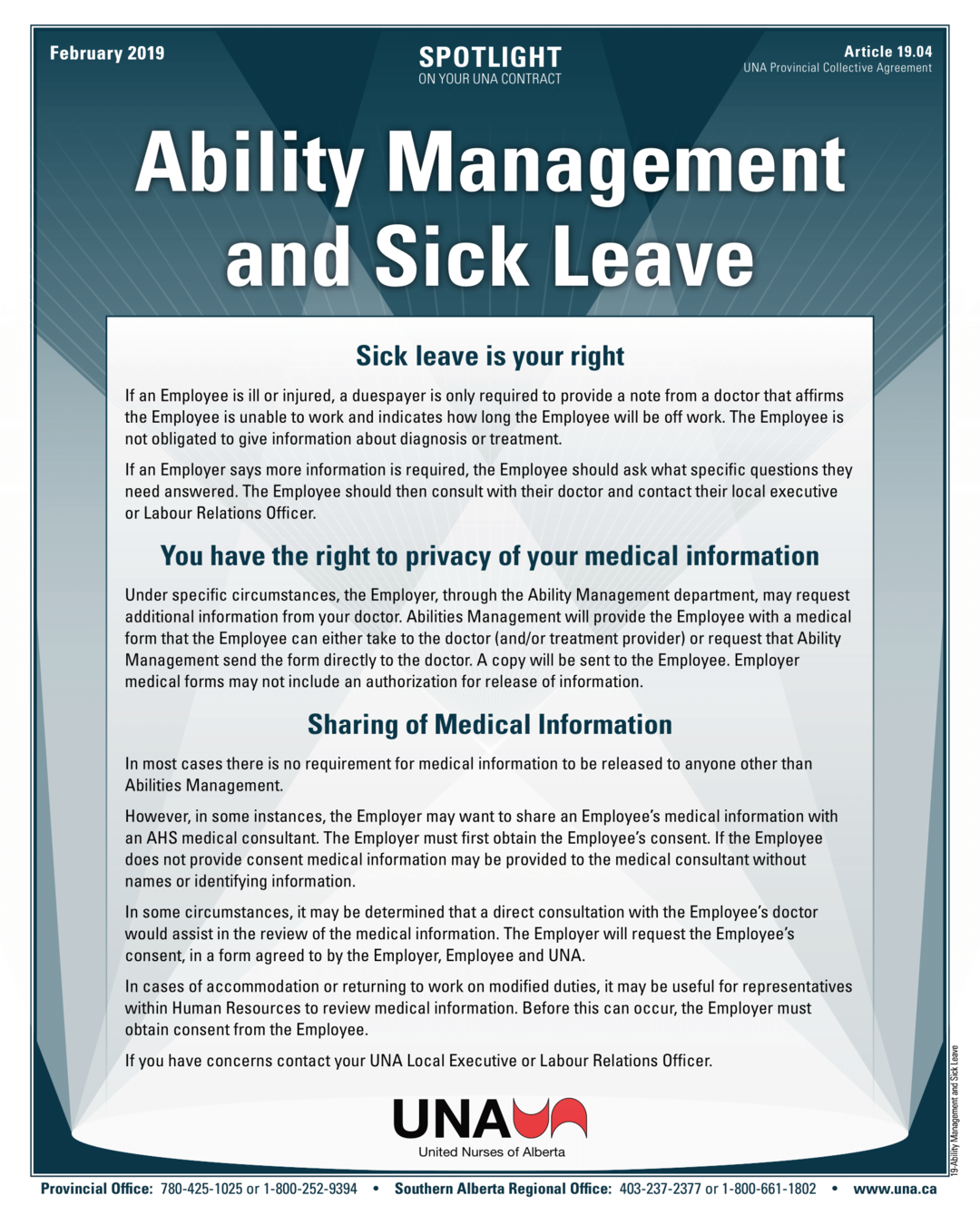
Sick leave is your right If an Employee is ill or injured, a duespayer is only required to provide a note from a doctor that affirms the Employee is unable to work and indicates how long the Employee will be off work. The Employee is not obligated to give information about diagnosis or treatment. If an Employer says more information is required, the Employee should ask what specific questions they need answered. The Employee should then consult with their doctor and contact their local executive or Labour Relations Officer. You have the right to privacy of your medical information Under specific circumstances, the Employer, through the Ability Management department, may request additional information from your doctor. Abilities Management will provide the Employee with a medical form that the Employee can either take to the doctor (and/or treatment provider) or request that Ability Management send the form directly to the doctor. A copy will be sent to the Employee. Employer medical forms may not include an authorization for release of information. Sharing of Medical Information In most cases there is no requirement for medical information to be released to anyone other than Abilities Management. However, in some instances, the Employer may want to share an Employee’s medical information with an AHS medical consultant. The Employer must first obtain the Employee’s consent. If the Employee does not provide consent medical information may be provided to the medical consultant without names or identifying information. In some circumstances, it may be determined that a direct consultation with the Employee’s doctor would assist in the review of the medical information. The Employer will request the Employee’s consent, in a form agreed to by the Employer, Employee and UNA. In cases of accommodation or returning to work on modified duties, it may be useful for representatives within Human Resources to review medical information. Before this can occur, the Employer must obtain consent from the Employee. If you have concerns contact your UNA Local Executive or Labour Relations Officer.
Employer cannot unilaterally schedule vacations
Employer cannot unilaterally schedule vacations
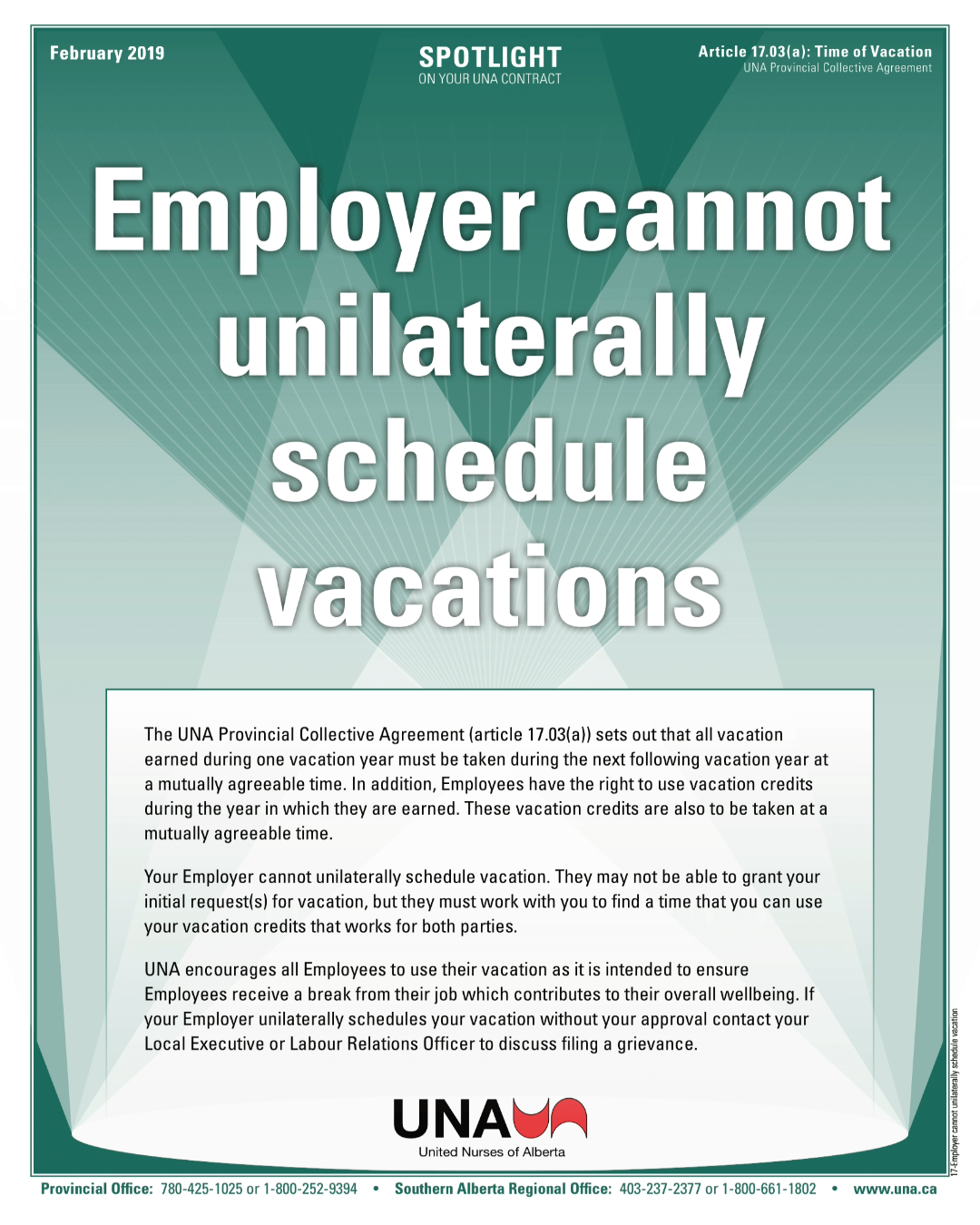
The UNA Provincial Collective Agreement (article 17.03(a)) sets out that all vacation earned during one vacation year must be taken during the next following vacation year at a mutually agreeable time. In addition, Employees have the right to use vacation credits during the year in which they are earned. These vacation credits are also to be taken at a mutually agreeable time. Your Employer cannot unilaterally schedule vacation. They may not be able to grant your initial request(s) for vacation, but they must work with you to find a time that you can use your vacation credits that works for both parties. UNA encourages all Employees to use their vacation as it is intended to ensure Employees receive a break from their job which contributes to their overall wellbeing. If your Employer unilaterally schedules your vacation without your approval contact your Local Executive or Labour Relations Officer to discuss filing a grievance.

Casual Employees eligible for overtime when they work in excess 147.25 hours in a four week period
Casual Employees eligible for overtime when they work in excess 147.25 hours in a four-week period